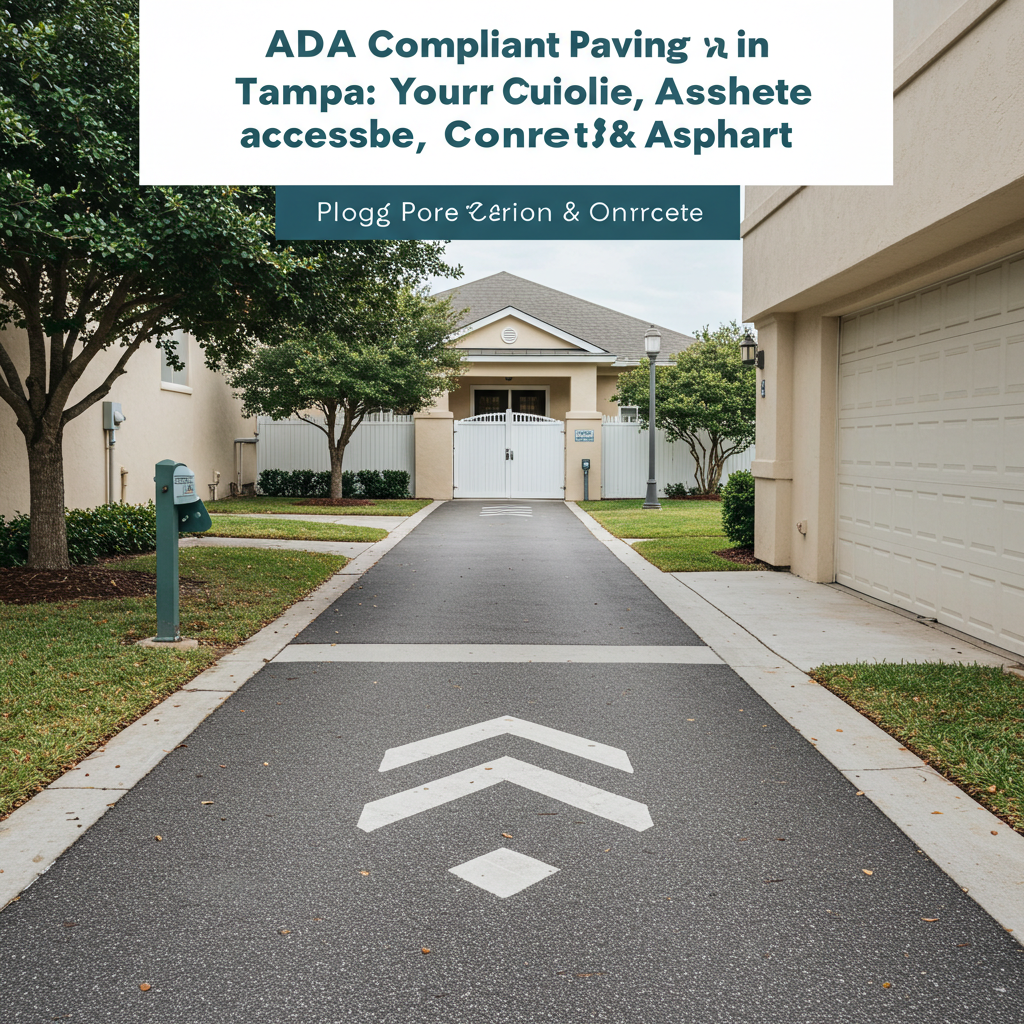
ADA Compliant Paving in Tampa: Your Guide to Accessible Concrete & Asphalt
Creating accessible environments is not just a legal requirement; it's a fundamental aspect of fostering an inclusive community. In Tampa, businesses, public facilities, and even residential complexes are increasingly recognizing the importance of ensuring their paved surfaces are accessible to everyone, including individuals with disabilities. The Americans with Disabilities Act (ADA) sets specific guidelines to eliminate discrimination against people with disabilities, and these guidelines extend significantly to the design and construction of paved areas like parking lots, sidewalks, and entryways. Navigating these requirements can be complex, but with the right knowledge and professional assistance, you can ensure your property provides safe, convenient access for all.
What Are the Key ADA Paving Requirements in Tampa?
The ADA is a comprehensive civil rights law prohibiting discrimination based on disability. For paving and concrete, its requirements ensure that physical barriers are removed, allowing individuals with disabilities to access and use facilities equally. While federal, these guidelines are enforced locally, impacting every paving project in Tampa.
- Accessible Parking Spaces: This is often the first point of contact for many. Parking lots must include a specific number of accessible spaces, clearly marked with the International Symbol of Access. These spaces must be wider than standard spots, typically 8 feet for the space itself and an adjacent 5-foot access aisle for vans, or 8 feet for the access aisle. Both the space and aisle must be level with minimal slope, and connect to an accessible route.
- Accessible Routes and Walkways: These are continuous, unobstructed paths connecting all accessible elements and spaces. In Tampa, an accessible route must have a minimum clear width of 36 inches, though 60 inches is preferred for two-way traffic. The surface must be firm, stable, and slip-resistant. Cross slopes should not exceed 1:48 (2%), and running slopes should generally not exceed 1:20 (5%). Any changes in level must be handled by ramps or gentle slopes.
- Curb Ramps: Essential for transitions between sidewalks and streets, curb ramps must have specific slopes (max 1:12 or 8.33%), clear landing areas, and detectable warning surfaces (truncated domes) at their base. The flared sides, if present, should not be steeper than 1:10, preventing tripping hazards. Proper drainage around curb ramps is also crucial to prevent water pooling.
- Surface Characteristics: All accessible paved surfaces, whether concrete or asphalt, must be firm, stable, and slip-resistant. This prevents wheels from sinking, ensures stability for walkers and wheelchairs, and reduces the risk of falls, especially in Tampa's often humid and rainy conditions. Rough or uneven surfaces can create significant barriers.
- Passage and Turning Space: Adequate clear space must be provided at doorways, gates, and intersections along accessible routes to allow individuals using wheelchairs or other mobility aids to maneuver comfortably without obstruction.
Why is ADA Compliant Paving Crucial for Tampa Businesses?
Beyond moral obligations, adherence to ADA standards carries significant legal, ethical, and business implications for any establishment operating in Tampa.
- Legal Compliance and Risk Mitigation: Failure to comply with ADA regulations can lead to costly lawsuits, substantial fines, and legal fees. Local government agencies and disability rights organizations actively monitor compliance, and individuals can file complaints. Ensuring your paving is compliant protects your business from potential litigation and financial penalties.
- Enhanced Reputation and Public Image: A business that actively demonstrates its commitment to accessibility is seen as inclusive and socially responsible. This positive image can attract a broader customer base, including individuals with disabilities, their families, and friends, who often choose to patronize establishments that prioritize accessibility. It reflects well on your brand in the Tampa community.
- Wider Customer Base and Increased Revenue: Over 25% of adults in the U.S. have some form of disability. By making your property accessible, you open your doors to a significant demographic that might otherwise avoid your business. This expanded customer base directly translates into increased foot traffic and potential revenue, making ADA compliance a smart business investment.
- Employee Accessibility: ADA compliance also extends to employees. An accessible workplace ensures that individuals with disabilities can comfortably and safely perform their jobs, fostering a diverse and equitable workforce.
- Community Integration: Accessible paving contributes to the overall integration of individuals with disabilities into the community, aligning with Tampa's goals for inclusivity and quality of life for all residents.
How Do I Ensure My Tampa Property Meets ADA Paving Standards?
Achieving and maintaining ADA compliance for your paved surfaces requires a systematic approach, often best handled by experienced professionals like Tampa Concrete & Paving.
- Professional Accessibility Audit: The first step is to have a qualified professional conduct a thorough audit of your existing paved areas. This audit identifies current deficiencies against ADA guidelines, pinpointing specific areas that need modification or reconstruction, such as incorrect slopes, missing ramps, or non-compliant parking spaces.
- Strategic Planning and Design: Based on the audit, develop a detailed plan for necessary modifications. This includes architectural drawings and specifications that clearly outline how ADA requirements will be met. Early planning is key, as incorporating accessibility from the design phase is far more cost-effective than making retroactive changes.
- Material Selection and Quality: Choose paving materials known for their durability, stability, and slip-resistance. For instance, well-finished concrete offers a smooth, firm surface, while correctly laid asphalt can provide adequate traction. The choice should also consider Tampa's climate, ensuring longevity and minimal maintenance.
- Precision Installation by Experts: ADA compliance hinges on precise execution. Slopes, widths, and transitions must be exact. This requires skilled paving contractors who understand ADA specifications intimately. Even a slight deviation in a ramp slope or parking space dimension can render it non-compliant.
- Ongoing Maintenance and Inspection: Paving surfaces degrade over time due to weather, traffic, and wear. Regular maintenance – repairing cracks, filling potholes, resurfacing, and re-striping – is crucial to ensure that accessible routes remain safe and compliant. Inspections should be periodic to catch new issues before they become compliance problems or safety hazards.
- Signage and Markings: Ensure all accessible parking spaces, routes, and features are clearly marked with appropriate signage and pavement markings, adhering to ADA graphic and color specifications.
What are Common ADA Paving Mistakes to Avoid in Tampa?
Even with good intentions, some common missteps can lead to non-compliance and potential issues.
- Incorrect Slope or Cross-Slope: This is perhaps the most frequent violation. Ramps that are too steep, or accessible routes with excessive cross-slope, make it incredibly difficult and unsafe for wheelchair users. Even slight deviations from the 1:12 ramp ratio or 1:48 cross-slope can be problematic.
- Inadequate Clearances and Turning Spaces: Failing to provide enough room for wheelchairs to maneuver, especially at doorways, turns, or in accessible restrooms, creates bottlenecks and barriers. Minimum clear widths of 36 inches for routes and sufficient turning radii are often overlooked.
- Missing or Non-Compliant Curb Ramps: Curb ramps are critical for seamless transitions. Mistakes include ramps without detectable warnings, those with steep side flares (creating tripping hazards), or ramps that drain directly into a pooling area rather than away from the path.
- Non-Compliant Accessible Parking Spaces: This includes insufficient numbers of accessible spaces, incorrect dimensions for the space or access aisle, lack of proper signage, or locating accessible spaces too far from an accessible entrance.
- Uneven or Damaged Surfaces: Potholes, cracks, buckling asphalt, or uneven concrete slabs on accessible routes or in parking lots create serious tripping hazards and make navigation difficult for anyone, especially those using mobility aids. Maintaining smooth, firm surfaces is paramount.
- Lack of Detectable Warnings: These textured surfaces, usually truncated domes, are essential at the bottom of curb ramps and other hazardous areas to warn visually impaired individuals of a change in elevation or approach to a vehicular area. Their absence or improper installation is a common mistake.
Ensuring your property's paving is ADA compliant is an ongoing commitment to accessibility and inclusion. For businesses and property owners in Tampa, understanding and implementing these standards is not just about avoiding legal trouble; it’s about serving the entire community with dignity and respect. At Tampa Concrete & Paving, we specialize in comprehensive ADA-compliant paving solutions. From initial accessibility audits and precise design to expert installation and ongoing maintenance, our team has the knowledge and experience to transform your paved surfaces into fully accessible, safe, and welcoming environments. Contact Tampa Concrete & Paving today for a consultation and let us help you create a truly accessible property.
Need Professional Assistance?
Get a free, no-obligation estimate from our expert local team today.