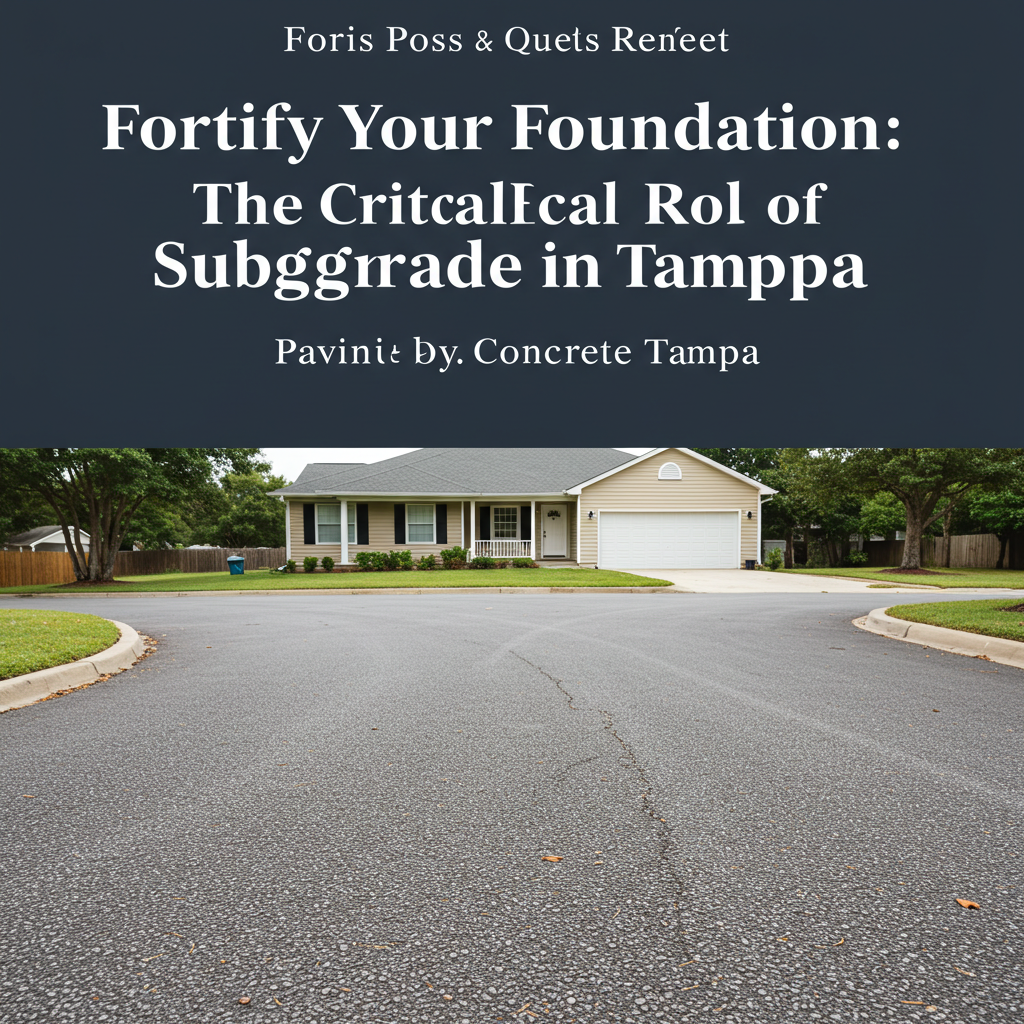
Fortify Your Foundation: The Critical Role of Paving Subgrade in Tampa
What is paving subgrade and why is it crucial for durable surfaces?
Paving subgrade refers to the natural soil or prepared fill material beneath the aggregate base course and the pavement surface itself. It is the ultimate foundation that supports the entire paving structure, distributing loads from vehicles to the underlying earth. Without a properly prepared and stable subgrade, even the highest quality asphalt or concrete surface will fail prematurely, leading to costly repairs and reduced lifespan.
In Tampa, where specific soil conditions and a high water table are common, understanding and properly preparing the subgrade is not just good practice—it's absolutely critical. The strength and stability of your pavement, whether a residential driveway, a commercial parking lot, or a public roadway, hinge directly on the quality of its unseen foundation.
Why is Subgrade So Important for Tampa Paving Projects?
The importance of subgrade cannot be overstated, especially in a region like Tampa. Our unique geological and climatic factors magnify the challenges associated with inadequate subgrade preparation. Here’s why it’s non-negotiable for lasting pavement:
- Load Distribution: The primary function of the subgrade is to support the pavement structure and distribute traffic loads uniformly to the underlying natural soil. If the subgrade is weak or uneven, it creates localized stress points that can cause cracking, rutting, and ultimately, structural failure of the pavement above.
- Water Management: Florida's frequent heavy rains and high water table pose significant threats. A properly designed and compacted subgrade, often incorporating drainage solutions, helps prevent water from infiltrating the pavement layers, which can lead to softening, loss of strength, and freeze-thaw damage (though less common in Tampa, saturation is a major issue).
- Stability and Settlement: Unstable or improperly compacted subgrade can settle unevenly over time. This differential settlement leads to dips, humps, and cracks in the surface, severely impacting ride quality and pavement longevity. In Tampa, expansive clay soils or poorly drained organic soils can exacerbate these settlement issues.
- Cost-Effectiveness: While investing in thorough subgrade preparation might seem like an added expense upfront, it is a significant cost-saver in the long run. A strong subgrade extends the life of your pavement, drastically reducing the frequency and cost of major repairs or full replacements.
What Are Common Subgrade Problems in Florida's Climate?
Tampa's climate and geology present specific challenges for subgrade integrity. Professionals must account for these factors during every paving project to ensure success:
- High Water Table: Many areas in Tampa have a naturally high water table, meaning groundwater is close to the surface. This can lead to saturated subgrade soils, which lose strength and stability significantly. Excess moisture reduces the soil's load-bearing capacity and can contribute to premature pavement failure.
- Expansive Clays and Organic Soils: While sandy soils are prevalent, some areas may have pockets of expansive clay soils that swell when wet and shrink when dry, causing movement and stress on the pavement. Organic soils, often found in low-lying or previously marshy areas, are notoriously unstable and compress significantly under load, leading to settlement.
- Poor Drainage: Inadequate site grading or drainage systems can allow surface water to pond or seep into the subgrade, saturating it and compromising its stability. This is particularly problematic during Tampa's intense rainy season.
- Improper Compaction: Even good soil types can be problematic if not compacted correctly. Insufficient compaction leaves voids in the soil, making it susceptible to further settlement under traffic loads and water infiltration. Over-compaction can also be an issue with certain soil types, creating brittle layers.
- Buried Debris or Utilities: Unidentified buried debris, old foundations, or utility lines can create inconsistencies in the subgrade, leading to localized weak spots and future pavement distress.
How Do Professionals Prepare and Stabilize Paving Subgrade?
Effective subgrade preparation by experienced professionals is the cornerstone of any durable paving project. Tampa Concrete & Paving employs a multi-step process to ensure a robust foundation:
- Site Assessment and Soil Testing: The first step involves thorough site investigation, including soil borings and laboratory testing. This identifies soil types, moisture content, density, and California Bearing Ratio (CBR) values, which indicate the soil's strength. This data guides the entire subgrade design.
- Clearing and Grading: The site is cleared of all vegetation, debris, and unsuitable topsoil. Rough grading establishes the desired elevations and slopes for proper drainage.
- Moisture Conditioning: Depending on the soil test results, the subgrade may need moisture adjustment. Dry soils might require wetting to achieve optimal compaction, while overly wet soils may need aeration, lime stabilization, or cement stabilization to dry them out and improve their properties.
- Compaction: This is a critical step. Heavy vibratory rollers are used to compact the subgrade to a specified density (e.g., 95-98% of maximum dry density). Proper compaction increases the soil's bearing capacity, reduces its permeability, and minimizes future settlement. Multiple passes are made, often in layers, to achieve uniform density.
- Stabilization (if needed): For very weak or problematic soils common in Tampa, stabilization techniques may be employed:
- Chemical Stabilization: Mixing agents like lime, cement, or fly ash into the subgrade soil chemically alters its properties, increasing strength, reducing plasticity, and improving resistance to moisture.
- Geotextiles and Geogrids: These synthetic fabrics or grids can be placed over weak subgrades to provide separation, filtration, and reinforcement, effectively bridging over soft spots and distributing loads more broadly.
- Aggregate Underlayment: In severe cases, a layer of stable aggregate (like crushed limestone) might be used as an improved subgrade layer, especially if the existing soil is highly unsuitable.
- Proof Rolling: After compaction, a heavy roller or truck is driven over the entire subgrade surface to identify any soft spots or areas that deform under load. These areas are then re-worked and re-compacted or stabilized as necessary.
When Should You Suspect Subgrade Issues Under Your Pavement?
Identifying subgrade problems early can save significant costs. While surface issues can arise from many causes, certain patterns strongly suggest an underlying subgrade deficiency:
- Extensive Alligator Cracking: This pattern, resembling alligator skin, indicates fatigue failure in the pavement layers due to repeated traffic loading. If it appears uniformly across a wide area, it often points to an inadequate subgrade not providing sufficient support.
- Rutting: Depressions that form in the wheel paths, especially on asphalt, signify a permanent deformation of the pavement layers, including the subgrade. This often occurs when the subgrade is too soft or poorly compacted and cannot withstand the repeated stress of vehicle tires.
- Depressions or Settlement: Localized sinking or uneven areas in the pavement surface, particularly in areas not directly under wheel paths, can indicate poor compaction, organic material decomposition, or varied soil conditions in the subgrade.
- Potholes that Reappear Rapidly: While potholes are common, if repairs repeatedly fail in the same spot, it often suggests a persistent issue with water infiltration and subgrade softening beneath that area.
- Standing Water: If water consistently pools on your paved surface after rain, it may not just be a surface drainage issue. It could indicate uneven settlement of the subgrade, creating low spots where water accumulates, further exacerbating subgrade weakening.
- Frequent Cracking Along Edges: Edge cracking can sometimes point to insufficient lateral support from the subgrade or shoulder, allowing the pavement to flex excessively at its weakest points.
What Are the Long-Term Benefits of Proper Subgrade Management?
Investing in professional subgrade preparation with Tampa Concrete & Paving yields numerous long-term advantages that extend far beyond initial installation:
- Significantly Extended Pavement Lifespan: A strong, stable subgrade is the single most important factor in maximizing the service life of your asphalt or concrete pavement. It reduces the rate of deterioration and delays the need for major rehabilitation.
- Reduced Maintenance and Repair Costs: With a robust foundation, your pavement will be less prone to cracking, rutting, and settlement, leading to fewer and less severe repairs over its lifetime. This translates into substantial cost savings.
- Enhanced Pavement Performance: A stable subgrade ensures a smoother, more comfortable ride for vehicles and a more stable surface for pedestrians. This is crucial for both aesthetic appeal and user safety.
- Increased Property Value: Durable, well-maintained pavement contributes to the overall aesthetic and functional value of your property, whether residential or commercial. It signals quality and attention to detail.
- Improved Drainage and Water Management: Proper subgrade preparation often includes integral drainage solutions that prevent water from compromising the pavement, protecting your investment from Tampa’s heavy rainfall.
- Environmental Responsibility: Longer-lasting pavements mean fewer resources consumed for frequent repairs and replacements, contributing to more sustainable infrastructure.
Don't let the unseen foundation of your pavement be an afterthought. The integrity of your driveway, parking lot, or private road in Tampa relies heavily on expert subgrade preparation. By prioritizing this crucial step, you're investing in decades of durability and performance.
For unparalleled expertise in subgrade assessment, preparation, and stabilization for any paving project in the Tampa Bay area, trust Tampa Concrete & Paving. Our team understands the unique challenges of Florida's soils and climate, ensuring your pavement is built on the strongest possible foundation from the ground up. Contact us today for a consultation and protect your investment for the long haul.
Need Professional Assistance?
Get a free, no-obligation estimate from our expert local team today.