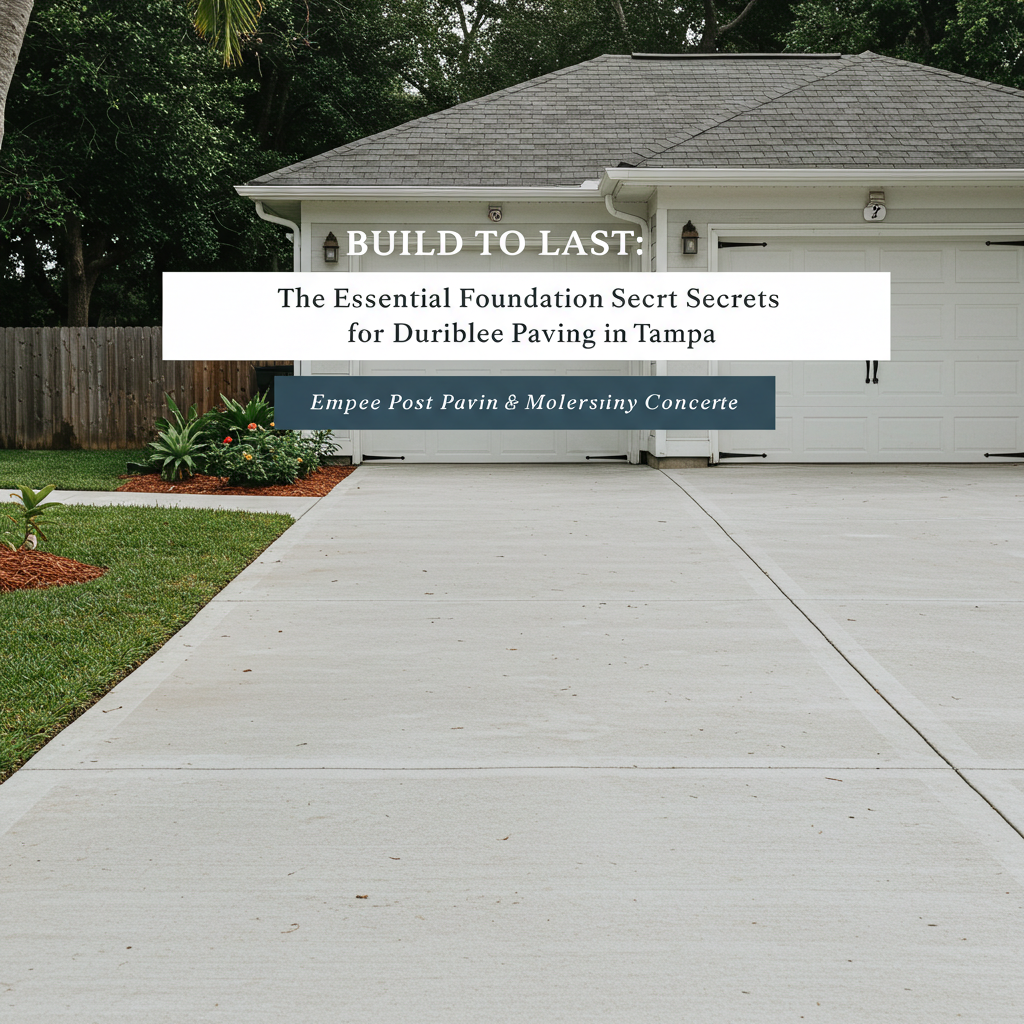
Build to Last: The Essential Foundation Secrets for Durable Paving in Tampa
Why is a Strong Paving Foundation Absolutely Essential for Tampa Properties?
In Tampa, a robust paving foundation isn't a luxury; it's a necessity. The unique environmental conditions of our region—including sandy soils, high water tables, relentless heat, and torrential seasonal rains—place immense stress on any paved surface. Without a properly constructed base, even the highest quality asphalt or concrete will fail prematurely. A strong foundation serves as the bedrock, distributing heavy loads, managing water, and providing the stability needed to prevent common issues like cracking, rutting, and uneven settling. It’s the unseen hero that dictates the longevity and performance of your driveway, parking lot, or private road.
- Load Distribution: The foundation spreads the weight of vehicles evenly, preventing concentrated stress points that can cause cracking and deformation.
- Water Management: A well-designed base prevents water from seeping into the subgrade, which can lead to expansion, contraction, and overall instability.
- Subgrade Protection: It acts as a barrier, protecting the softer underlying soil from erosion and weakening due due to moisture.
- Thermal Stability: In Tampa's heat, the foundation helps mitigate temperature-related expansion and contraction of the paving material, reducing stress.
What Specific Steps Guarantee an Optimal Paving Base in Tampa's Climate?
Achieving an optimal paving base in Tampa requires a meticulous, multi-step process, each crucial for long-term durability. Skipping any of these steps can compromise the entire project's integrity, leading to expensive future repairs.
- Site Preparation and Clearing: The first step involves clearing the area of all vegetation, debris, and unsuitable soil. This ensures a clean slate for construction.
- Excavation and Grading: The site is then excavated to the required depth, and the subgrade (the natural soil beneath the pavement structure) is carefully graded to establish the proper slopes for drainage. Correct grading prevents water ponding and directs runoff away from the paved surface.
- Subgrade Compaction and Stabilization: The exposed subgrade is compacted to achieve maximum density and stability. In areas with particularly weak or unstable soils, soil stabilization techniques—such as mixing in lime, cement, or fly ash—may be employed to improve bearing capacity and reduce moisture susceptibility. This is especially critical in Tampa's often sandy or clay-rich soils.
- Base Course Material Selection and Placement: A high-quality aggregate material, such as crushed concrete or limerock, is then spread over the compacted subgrade. The choice of material often depends on local availability and project specifications, but it must be durable and well-graded.
- Layered Compaction: The base course is typically applied in multiple layers, or
Need Professional Assistance?
Get a free, no-obligation estimate from our expert local team today.